Best of the Week: Motion, Mass, and Material
This week's strongest work shared a structural quality: every piece has something physically legible about it. A typeface built for dominance at frame-filling scale. A packaging system where every visible decision traces back to a constraint. A brand identity where instability is the point, not a failure. The editorial throughline for W18 is design that communicates through the body of its elements — through weight, surface, and material — rather than through labels and intent.
Ten picks this week. Eight from Abduzeedo's own coverage, two from outside. All of them earned their place by having a specific reason to exist.
MakeMake — The Dinosaurs Title Sequence (Netflix)
MakeMake's main titles for Netflix's Colossal Earth: The Dinosaurs work as visual camouflage: creatures are folded into valley floors and mountain crags, their scale only registering as the camera holds long enough for the eye to re-read the landscape. The compositional idea and the technique are the same thing — this is not a sequence where you can separate concept from execution. The still frames hold on their own because the geometry is structural, not decorative. The meteorite impact sequence, built from fluid simulation and rigid body dynamics, closes on a geological event with the same visual patience as the opener.
Rajesh Rajput — Million Typeface (18 Styles / Variable)
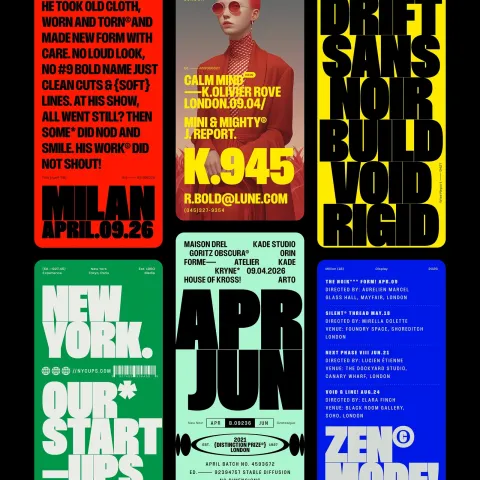
Million is a condensed display typeface in 18 styles with a variable weight axis, and it was designed for situations where the type occupies the full frame rather than sitting inside it. The specimen layouts demonstrate this directly — wordmarks bleeding off all four edges, weight progressions that read as physical material rather than stylistic variation, advertising mockups where the letterforms are the entire visual event. The specimen itself is the argument: if you need proof that this typeface works at dominance scale, the gallery is the proof. Rajesh Rajput practices what New Delhi's design scene produces when it stops deferring to Western display conventions.
Unspoken Agreement — SanDisk Packaging System
Unspoken Agreement redesigned SanDisk's packaging as a scalable modular system — one visual language that works across SD cards, USB drives, and SSDs without the system feeling diluted at any product tier. The 3D renderings are not decoration; they served as the system's proof-of-concept before production, demonstrating flexibility across form factors before any tooling decisions were made. The organizing constraint — waste reduction without compromising shelf presence — is visible in every decision: the system earns its environmental claims through engineering rather than messaging.
Plus X — KT Visual Identity Renewal
An 11-person team at Plus X built KT's new corporate identity system across 22 documented applications — from billboards to app icons — for a telecom operator that has to be everywhere in one of the world's most screen-dense markets. The hard design problem for a brand at this scale is not what it looks like but what it standardizes versus what it lets breathe across contexts. Plus X's decisions about where to hold the system tight and where to leave room for environmental variation are the practical lesson here. Best of Behance, 6,300 views, 730 appreciations — this is the kind of work that gets validated by designers who work at enterprise scale.
Akatre Studio — Symbiosis
Seven images. No text, no setting, no explanatory frame — just surface rendered at a scale where the familiar becomes architectural. Akatre's Symbiosis is macro and still-life photography built on the principle that removing context makes material strange. A Paris studio known for work at the intersection of art direction and photography, Akatre apply the same visual discipline here that drives the most-saved work in the design community: surface as subject, the removal of scale reference as the generative move. What reads as texture at normal scale reads as landscape when the reference is gone.
Gudrix Agency — AI-Powered Personal Finance App
Gudrix Agency led the full process — user research through developer handoff — for a personal finance product with an AI layer, and the notable design choice is what they did not do: they refused to make the AI the visual centerpiece. The AI shows up in the information architecture, not the aesthetic vocabulary. The result looks more like a music app than a fintech dashboard — which is the argument. In a category that has converged on the same dark-mode, data-dense look, the decision to break visual category convention is itself a UX position. 830 appreciations, 8,800 views on Behance.
Sleeko Studio × DewApples Studio — CRAVEA Coffee Brand
CRAVEA is what independent studios produce when they own the entire experience end-to-end: branding, packaging, UX, and motion design treated as a single design problem rather than consecutive phases. In coffee branding — a category saturated with artisan-minimal aesthetics — the question of what makes a system feel coherent across physical packaging and digital touchpoints is the hard design problem this project addresses directly. The two-studio collaboration model (Sleeko + DewApples, Bangladesh) is also worth noting: it's how independent practices are competing against larger agencies at full-stack brand scope. 9,500 views, 1,000 appreciations.
Mina Wright — Ruff Lamp (3D Print)
The Ruff Lamp is a 3D-printed object designed to look like it was made wrong — rough layers, compressed form, the kind of surface that records process rather than hiding it. What makes it a design object rather than a prototype is precisely the commitment to that aesthetic: the texture is not a fabrication artifact to be sanded away, it's the point. In a week full of systems thinking and scale, Mina Wright's lamp is a counterpoint — a single object at human scale, where the material and the making are the whole argument.
Pentagram (Samar Maakaroun) — The Mosaic Rooms Identity
Pentagram partner Samar Maakaroun built an identity for The Mosaic Rooms — a West London institution dedicated to contemporary culture from the Arab world — that deliberately encodes instability. The monogram extends in both directions simultaneously, acknowledging Arabic's right-to-left reading and English's left-to-right without committing to either. The article in Creative Boom is worth reading in full: there is a particular kind of bravery involved in designing instability into the foundations of a brand system, and Maakaroun frames it precisely — not as concept-first decoration but as the institution's actual condition made visible. Published April 28, 2026.
LOVE — LARK Whisky Rebrand
Manchester-based LOVE rebranded Tasmanian distiller LARK by ignoring the entire whisky category playbook — no tartan, no heritage serif, no copper-still photography. The LARK wordmark was redrawn to reference Tasmanian leaf forms and the skylark's beak; the bottle silhouette mirrors a bird in flight; sculpted facets at the base evoke layered feathers. Every design decision answers to a strategy grounded in genuine Tasmanian place identity rather than borrowed luxury conventions. The result is a whisky brand that establishes premium credentials from scratch — which is the harder problem. Published April 29, 2026.
Next week: We're watching for follow-up work from Milan Design Week and keeping close to what's landing on Behance in generative and data-driven design. If there's a stronger week than W18 in Q2, it'll need something to say.